Ask any experienced landlord in Cumbria what sells beer, and somewhere near the top of the list — alongside a warm welcome and a good pint price — you'll hear one word: temperature. The quality of every pint you pour begins in the cellar, hours before it ever reaches the tap. A cellar that's too warm produces flat, fobbing, off-tasting beer and shocking wastage figures. A cellar that's too cold creates hazy, lifeless pints and inflated energy bills. After decades servicing hospitality venues across Carlisle, the Lake District and South West Scotland, we've seen exactly how much money a struggling cellar cooling system quietly drains from a business. This guide covers everything you need to know to protect your beer, your reputation and your margins.
The Magic Number: Why 11–13°C Matters So Much
The industry standard for a beer cellar is a constant 11–13°C, and that range isn't arbitrary. Cask Marque, the independent body that accredits beer quality in UK pubs, inspects cellar temperature as a core part of its assessments — because cask ale is a living product. Too warm, and secondary fermentation accelerates: the beer turns over too quickly, throws excess CO2, fobs at the tap and spoils within days. Too cold, and the yeast goes dormant, conditioning stalls, and you pour cloudy, dull pints that customers send back.
Keg products are more forgiving but far from immune. Warm kegs cause excessive fobbing at dispense — and every pint of fob that goes down the drain is profit going with it. Across a busy weekend, a cellar running just three or four degrees warm can cost a venue a genuinely painful amount in wastage alone, before you even count the reputational cost of a bad pint in the age of online reviews.
Quick check: Put a thermometer in your cellar away from the cooling unit and the door, and check it at the warmest point of the day. If you're seeing readings above 13°C in June, you have a problem that will only get worse by August — the busiest, hottest weeks of the Cumbrian tourist season.
How a Cellar Cooling System Actually Works
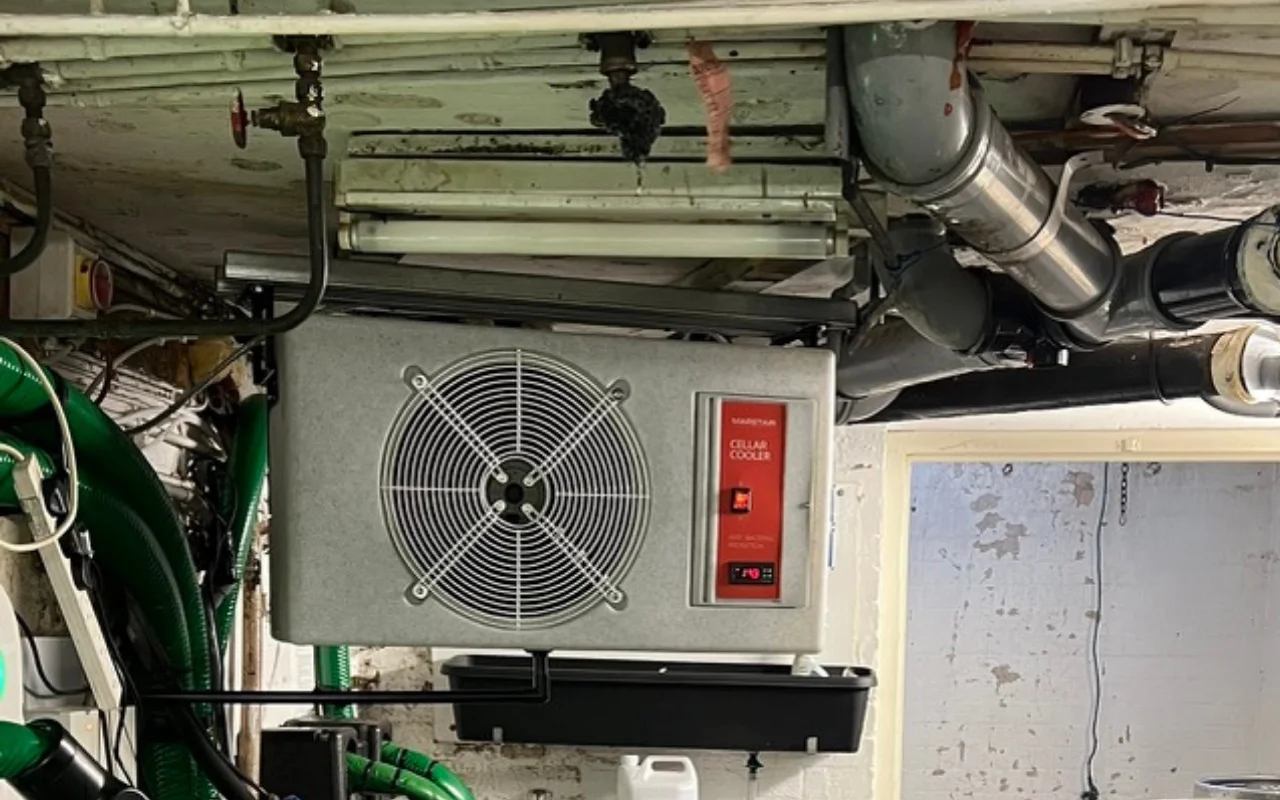
A cellar cooling system works on the same refrigeration principles as the equipment behind your bar, scaled up to condition an entire room. An evaporator unit inside the cellar absorbs heat from the air, and a condenser unit outside rejects that heat to the atmosphere, with refrigerant cycling between the two through insulated pipework. A thermostat holds the room at your set point, and a condensate drain carries away the moisture the system pulls from the air.
Sizing is everything. The system must overcome heat from every source: warm summer air leaking through doors and hatches, heat radiating through uninsulated walls and ceilings (especially under kitchens), warm deliveries of stock, lighting, line-cleaning equipment, and remote coolers or bottle fridges sharing the space. An undersized unit runs flat-out all summer, drives up electricity bills, and fails early. An oversized one short-cycles and controls temperature poorly. This is why a proper site survey — measuring the room, assessing insulation and cataloguing heat sources — matters far more than simply matching the model number of whatever was there before.
Seven Warning Signs Your Cellar Cooling Is Failing
Cellar coolers rarely die without warning. In our experience attending refrigeration repairs across the region, these are the signs landlords most often ignore until a heatwave forces the issue:
- Temperature swings — the cellar reads 11°C in the morning and 15°C by evening. Healthy systems hold steady.
- The unit never stops running — constant operation suggests the system is losing the battle, often due to low refrigerant, a tired compressor or dirty coils.
- Ice on the evaporator — ice build-up indicates airflow or refrigerant problems and dramatically reduces cooling capacity.
- New noises — rattles, grinding or hissing usually mean failing fan motors, loose components or a refrigerant leak.
- Water where it shouldn't be — pooling water points to a blocked condensate drain, which can damage stock and create slip hazards.
- Rising electricity bills — a struggling system can use dramatically more energy. The Carbon Trust notes that refrigeration is one of the largest energy costs in hospitality, and poorly maintained equipment makes it significantly worse.
- Beer quality complaints — if your fob levels are creeping up or your cask ale is turning before the barrel empties, check the cellar before blaming the brewery.
Catching these signs early usually means an affordable repair. Ignoring them usually means a dead system on the hottest Saturday of the year — with every other venue in Cumbria calling the same engineers at the same time.
Repair, or Replace? An Honest Framework
We will always repair a system where repair makes economic sense — it's a point of pride. But there are cases where replacement is genuinely the cheaper path over three to five years. As a rule of thumb, consider replacement when the unit is over 12–15 years old, when it uses an obsolete refrigerant that's now restricted and expensive under the UK's F-gas regulations, when this is the second or third major repair in two years, or when your trade has grown and the system was never sized for today's stock levels. Modern units are markedly more efficient, so the energy savings alone can offset a meaningful slice of the installation cost.
What a Professional Installation Involves
A proper cellar cooling installation is a full project, not just a box on the wall. When Be Cool installs a system, the process looks like this:
Our Installation Process
Because cellar coolers contain F-gas refrigerants, installation and refrigerant handling are legally restricted to qualified engineers — the same rules that apply to air conditioning. Always confirm your installer's F-gas credentials, and be wary of general handymen offering cut-price installs. Beyond legality, refrigerant safety in enclosed cellars is a genuine workplace hazard the Health and Safety Executive takes seriously, and your insurance may be void if work wasn't carried out by certified professionals.
Beyond Beer: Wine Cellars and Food Storage
While beer cellars are our most common call-out, the same engineering applies to other temperature-critical spaces. Wine storage demands a slightly different set point — typically a steady 12–14°C with stable humidity — and fluctuations matter even more, because repeated temperature swings age wine prematurely and ruin valuable stock. For restaurants and hotels in the Lake District holding serious wine lists, a dedicated conditioned space is an investment that protects thousands of pounds of inventory.
Similarly, many venues use cooled cellars and cold rooms for food storage alongside their drinks operation. If that's your setup, the stakes include food safety compliance as well as quality, and the system needs to be specified for the combined load. Our refrigeration installation team designs cold rooms and cellar systems for exactly these mixed-use requirements.
Five Habits That Extend the Life of Your System
Between professional services, good cellar discipline keeps your cooling system healthy. Keep the cellar door closed — every minute it stands open in summer dumps heat the system must remove again. Don't use the cellar as general storage; cluttered evaporator airflow cripples performance. Bring deliveries in efficiently rather than leaving the drop hatch open. Keep the condenser unit outside clear of leaves, packaging and debris. And book a professional service every year, ideally in spring — a pre-season clean, gas check and inspection costs a fraction of an emergency call-out in July, and it's the single best insurance policy your cellar can have.
Frequently Asked Questions
What temperature should my beer cellar be?
A constant 11–13°C. Cask ale conditions and serves best in this range, while keg products are chilled further at the point of dispense by remote coolers.
How much does cellar cooling installation cost?
It depends on cellar size, insulation and heat loads, which is why we quote only after a free site assessment. You'll receive a transparent fixed price covering the unit, pipework, drainage and full commissioning — no hidden fees.
Can you service or repair a system you didn't install?
Absolutely. We repair and service all makes and models of cellar cooling equipment across Carlisle, the Lake District, Whitehaven, the West Coast and South West Scotland.
How quickly can you attend a breakdown?
We prioritise urgent breakdowns — we know a warm cellar in peak season is an emergency, not an inconvenience — and aim to be on-site as quickly as possible.
Protect Your Pints — and Your Profits
Your cellar is the engine room of your business. Whether you run a village pub near Carlisle, a Lakeland hotel bar or a restaurant on the West Coast, a properly specified, professionally maintained cellar cooling system pays for itself in reduced wastage, lower energy bills and consistently excellent beer. As a family-run firm with nearly 30 years in the trade, Be Cool offers free site assessments, honest advice and fixed-price installations across Cumbria and South West Scotland.